Born in Lyon from Paul Bocuse’s vision of bringing chefs into the spotlight, the Bocuse d’Or has become one of gastronomy’s most coveted stages. Today, Team Vietnam carries its own story into this extraordinary culinary arena, shaped by heritage, ambition and a new generation ready to give Vietnamese cuisine a global voice.
There are moments when a chef cooks for a restaurant, moments when a chef cooks for a guest, and rare moments when a chef cooks for a country. For nearly four decades, the Bocuse d’Or has transformed that idea into one of the great spectacles of international gastronomy. Created in Lyon in 1987 by the legendary Paul Bocuse, the competition was revolutionary from the beginning. At a time when culinary contests largely unfolded away from public view, Bocuse imagined something altogether different: chefs cooking live, against the clock, before an international jury, cameras and cheering spectators. Gastronomy would leave the secrecy of the kitchen and step into the spotlight.
The atmosphere remains unlike almost anything else in fine dining. There is the discipline and precision of haute cuisine, but also the emotion and energy of sport. National flags fill the stands, supporters cheer for their teams and chefs perform under extraordinary pressure. Behind those few intense hours are months, sometimes years, of preparation, refinement and repetition. National selections lead to continental competitions, from which the finest teams earn the coveted opportunity to reach the Grand Final in Lyon.
Yet the enduring fascination of the Bocuse d’Or lies beyond technical perfection. At its heart is a beautifully simple question asked of every chef who enters its kitchens: Who are you, and where do you come from? For Vietnam, that question opens an extraordinary world of possibilities.
A Vietnamese Voice
Vietnam comes to the table with a culinary language already rich in nuance. There is the perfume of herbs picked moments before serving, the brightness of lime and tamarind, the depth of fermentation, the patience of a broth left quietly simmering, the aroma of charcoal and the unmistakable salinity of the sea.
.png)
There is the abundance of the Mekong Delta, the refined culinary traditions of Huế, the seafood of the central coast, the produce of the highlands and the countless regional dishes that change in character as one travels the length of the country.
These are flavours born not simply from recipes, but from geography, climate, memory and generations gathered around the family table.
The challenge for Bocuse d’Or Team Vietnam is therefore not to transform Vietnamese cuisine into somebody else’s interpretation of fine dining. It is something far more compelling: to take this extraordinary inheritance and discover how it can speak through the precision, elegance and creativity of contemporary gastronomy.
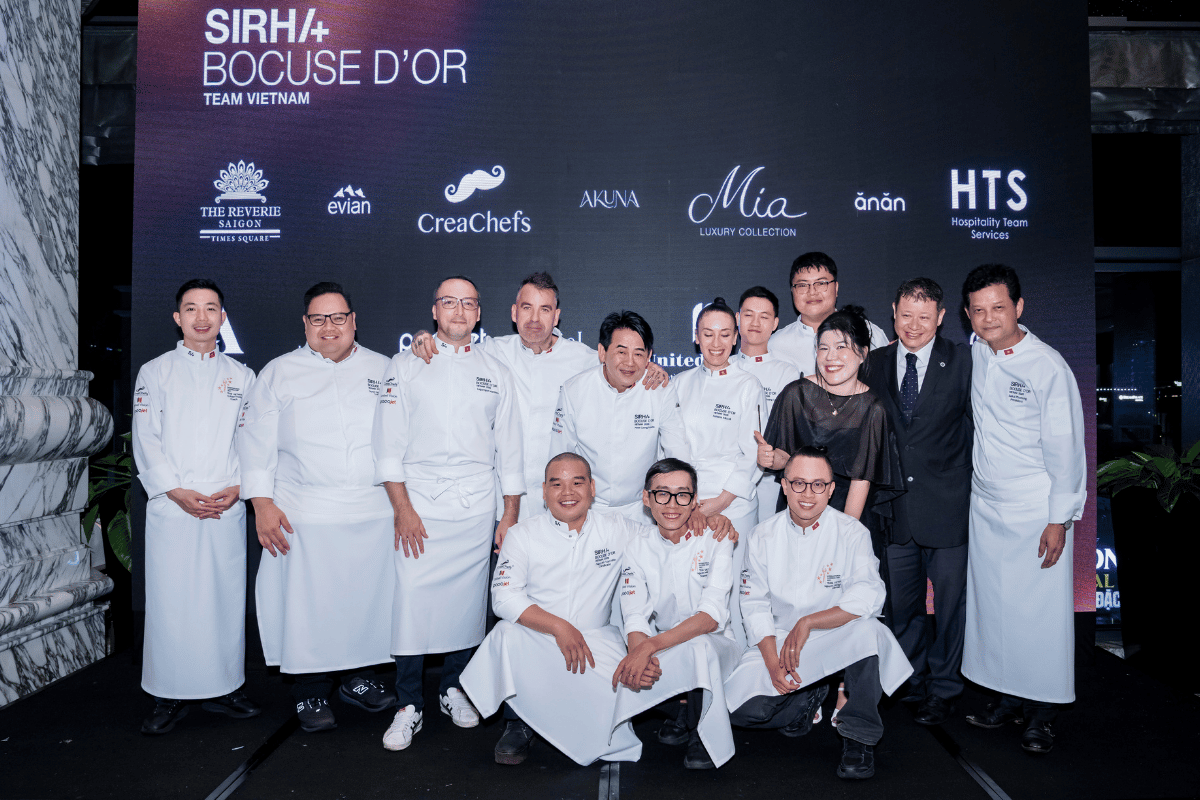
At the centre of Team Vietnam’s recent journey is Chef Vũ Xuân Trường, Vietnam Candidate 2025, alongside commis Nguyễn Quang Tâm. Guiding them is Daniel Nguyen, Coach of Bocuse d’Or Vietnam, under the leadership of Chef Sakal Phoeung, President of Bocuse d’Or Vietnam. Together, they represent a collective ambition to bring Vietnamese culinary talent, heritage and creativity onto one of gastronomy’s most prestigious international stages. This sense of collective purpose is important because no chef reaches the Bocuse d’Or kitchen alone.
.png)
Behind every candidate stands a commis, a coach, mentors, partners and an entire community. The movements between candidate and commis must become almost instinctive. A garnish may be reconsidered dozens of times. Temperatures are adjusted by degrees. Presentations are created, dismantled and created again. Every second matters. Yet when the final dish reaches the jury, none of that effort should be visible. There should only be pleasure.
When Technique Becomes Emotion
Perhaps this is where the Bocuse d’Or and the philosophy of great dining meet most beautifully. Technique matters enormously, but technique alone rarely creates a memorable meal. What remains is emotion: an aroma that returns us to childhood, an unexpected texture, the discovery of an ingredient never encountered before, or a familiar flavour presented in a way that makes us experience it anew.
For a Vietnamese chef on the international stage, the possibilities are almost limitless. A humble ingredient can be elevated without losing its identity. A traditional technique can find new expression in a contemporary context. A memory from a family kitchen can become the inspiration for a plate of extraordinary refinement. Sophistication lies not in disguising where something comes from, but in revealing its essence more clearly. And therein lies perhaps Vietnam’s greatest opportunity.
.png)
The country’s gastronomic landscape is undergoing a remarkable transformation. A new generation of Vietnamese chefs is travelling, learning and returning home with fresh perspectives. Others are looking inward, rediscovering indigenous ingredients, regional traditions and recipes once considered too familiar to belong within the vocabulary of fine dining.
Increasingly, international technique and Vietnamese memory are finding a natural place on the same plate. The Bocuse d’Or can deepen that conversation. Competition creates discipline, but it also creates transmission. The commis of today may become tomorrow’s candidate. The candidate may one day become a coach. Knowledge moves from one generation to another, and the experience accumulated through months of preparation eventually finds its way back into restaurant kitchens, culinary schools and the wider hospitality community. In this sense, a medal is only one measure of success. The greater prize may be what remains afterwards.
The Road To Lyon
The Bocuse d’Or is approaching a particularly symbolic chapter. In January 2027, the world’s finest teams will return to Lyon for a Grand Final marking the competition’s 40th anniversary.
Four decades after Paul Bocuse first imagined chefs stepping from behind the kitchen doors and into the international spotlight, his vision has grown into a global culinary movement, bringing together nations, cultures and generations through a shared pursuit of excellence.
.png)
Vietnam is now part of that conversation. But the significance of this journey should not be measured solely by whether the country’s name appears on a podium. Something deeper is taking place.
Every international appearance creates experience. Every training session raises standards. Every chef who follows Team Vietnam’s journey sees that the distance between a Vietnamese kitchen and the world’s most prestigious culinary stages is no longer unimaginable.
And every time Vietnam cooks beneath its national flag, it has another opportunity to tell the world who it is. That story needs no embellishment. Vietnam already possesses the ingredients, the traditions and the memories. What is emerging now is the confidence to reinterpret them.
Perhaps a future Bocuse d’Or plate will evoke the mist rising above a morning market in the Mekong Delta. Another might carry the perfume of the central highlands, the salt of the Vietnamese coast or a flavour remembered from a grandmother’s kitchen. The technique may be international and the presentation contemporary, but the emotion should remain unmistakably Vietnamese. That is when competition becomes something more meaningful. It becomes cultural expression.
Nearly forty years ago in Lyon, Paul Bocuse imagined a stage where chefs could become ambassadors for their craft and their countries. Today, Vietnam has its place within that extraordinary conversation.
The next chapter belongs to the chefs willing to carry it forward, with discipline in their hands, memory in their cooking and Vietnam in their hearts. Because reaching the world’s table is only the beginning. The greater ambition is to give the world a taste it will remember as unmistakably Vietnam.