Through hand-carved woodcuts and intricate illustrations, Jack Clayton turns Vietnam’s histories, streets and symbols into richly layered visual narratives. A British printmaker and illustrator based in Ho Chi Minh City since 2012, his work brings together the bold graphic force of European Expressionism, the compositional elegance of Japanese Ukiyo-e and more than a decade of close observation in Vietnam.
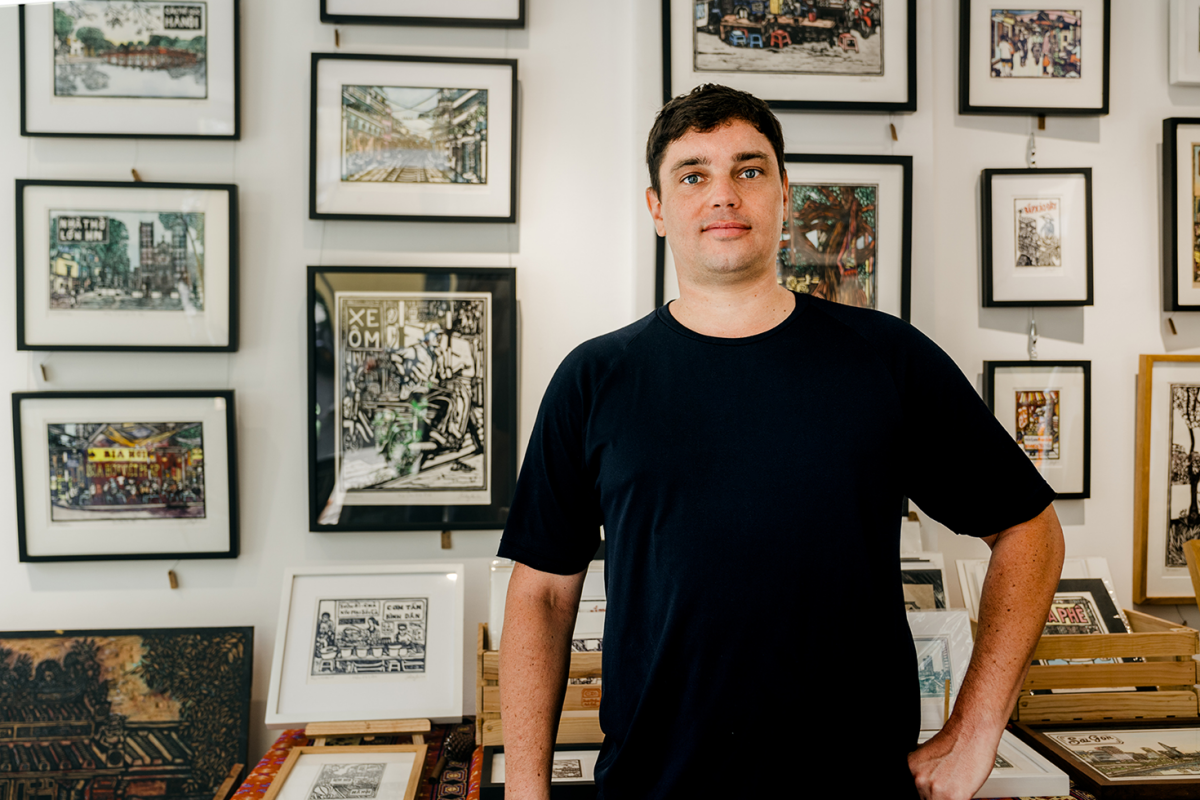
Clayton’s images are never simple records of place. They are built like visual maps, filled with patterns, shifting scales and small details that slowly reveal themselves. A district, a street corner, an ancient motif or a familiar scene from everyday life can become part of a wider story. The longer one looks, the more the image opens.
His artistic foundation began in the United Kingdom, where he studied Graphic Arts and Design at Leeds Metropolitan University. A short residency at the Frans Masereel Centrum in Belgium later deepened his understanding of woodcut and experimental printmaking. It was there that he found a medium capable of carrying both graphic strength and narrative depth.
Before settling in Vietnam, Clayton spent two years in Australia, including time in Kakadu National Park. His encounters with Indigenous art left a lasting impression, especially the idea that meaning can be embedded in pattern, surface and detail. This sensitivity to hidden narratives continues to shape the way he constructs his compositions today.
Ho Chi Minh City became a decisive chapter in his practice. After arriving in Vietnam during a journey through Southeast Asia, Clayton was drawn to the city’s energy, density and contrast. Following several years of teaching English and rediscovering his artistic direction, he became a full-time artist in 2019 and opened his own gallery studio in Khanh Hoi, District 4.
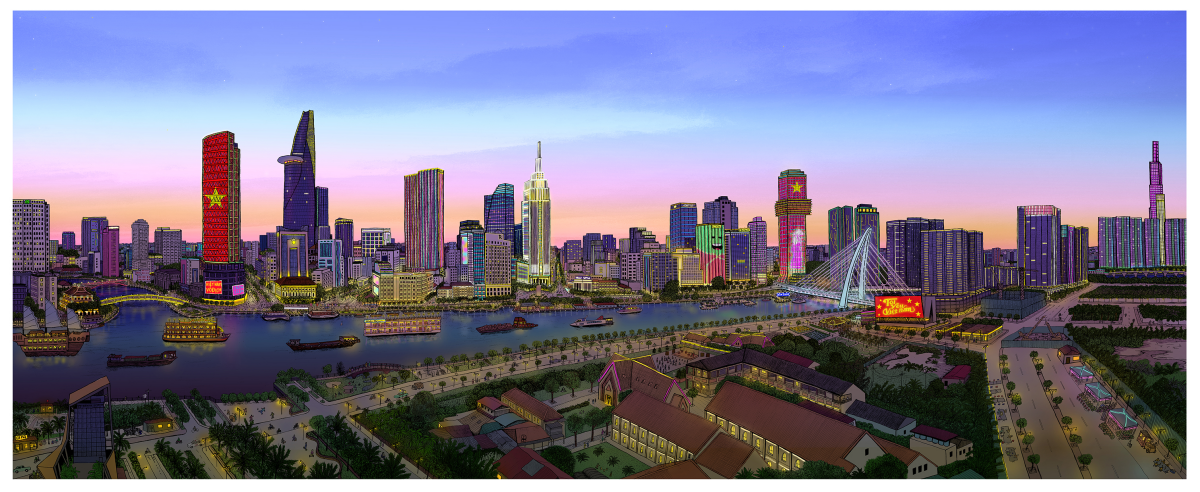
His illustration practice is rooted in both research and instinct. Each work begins as a hand-drawn pen and pencil composition before being refined digitally into its final design. The subjects often come from two parallel sources: Vietnam’s deep historical heritage and the vivid culture of its modern streets. Projects such as Dong Son Drum Triptych and Saigon Compass reflect this dual interest, exploring Vietnam not as a fixed image, but as a place of movement, memory and layered identity.
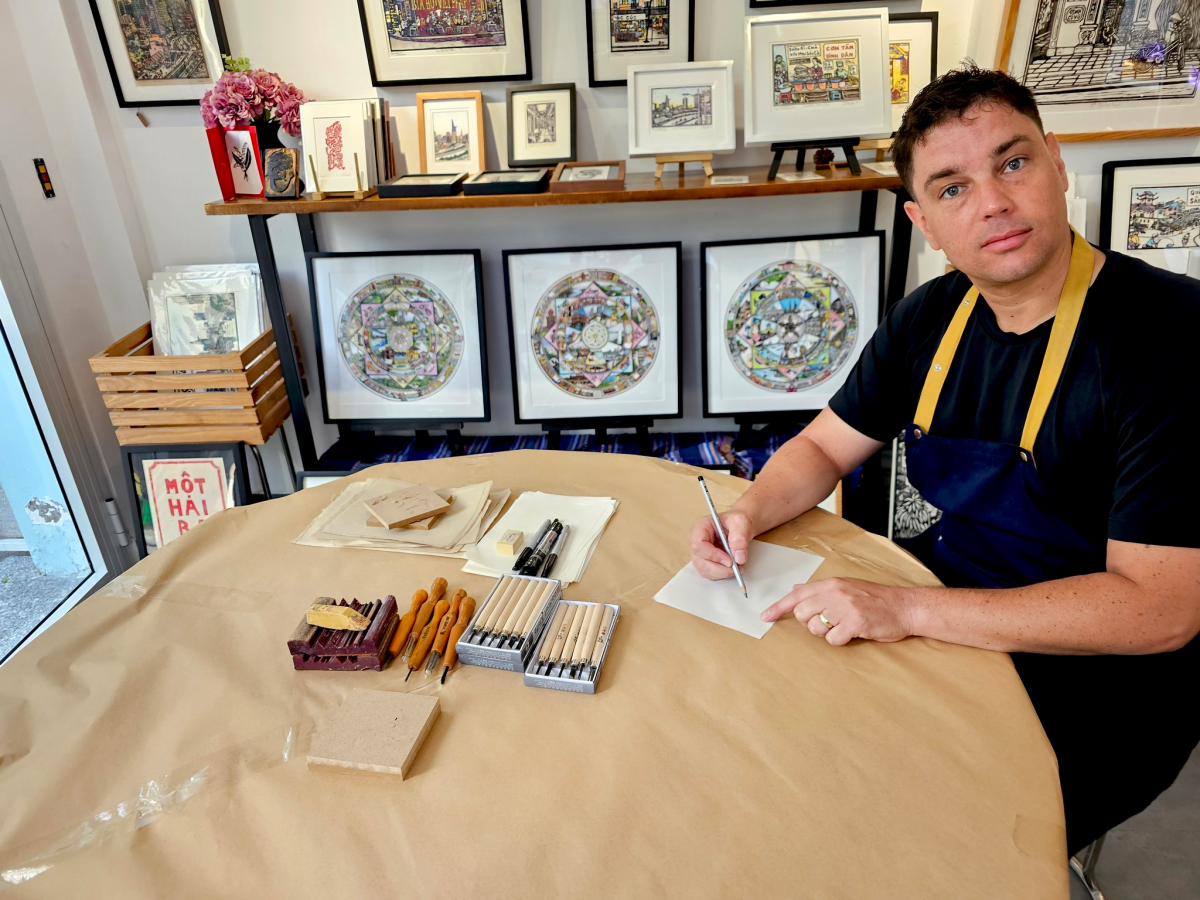
At the centre of Clayton’s work is the discipline of handmade printmaking. His woodcut prints are carved from his own illustrations, then hand-burnished without a press. He frequently uses the reduction method, creating multiple layers of colour and depth from a single block of wood. As the surface is gradually carved away, the process makes each print genuinely unrepeatable.
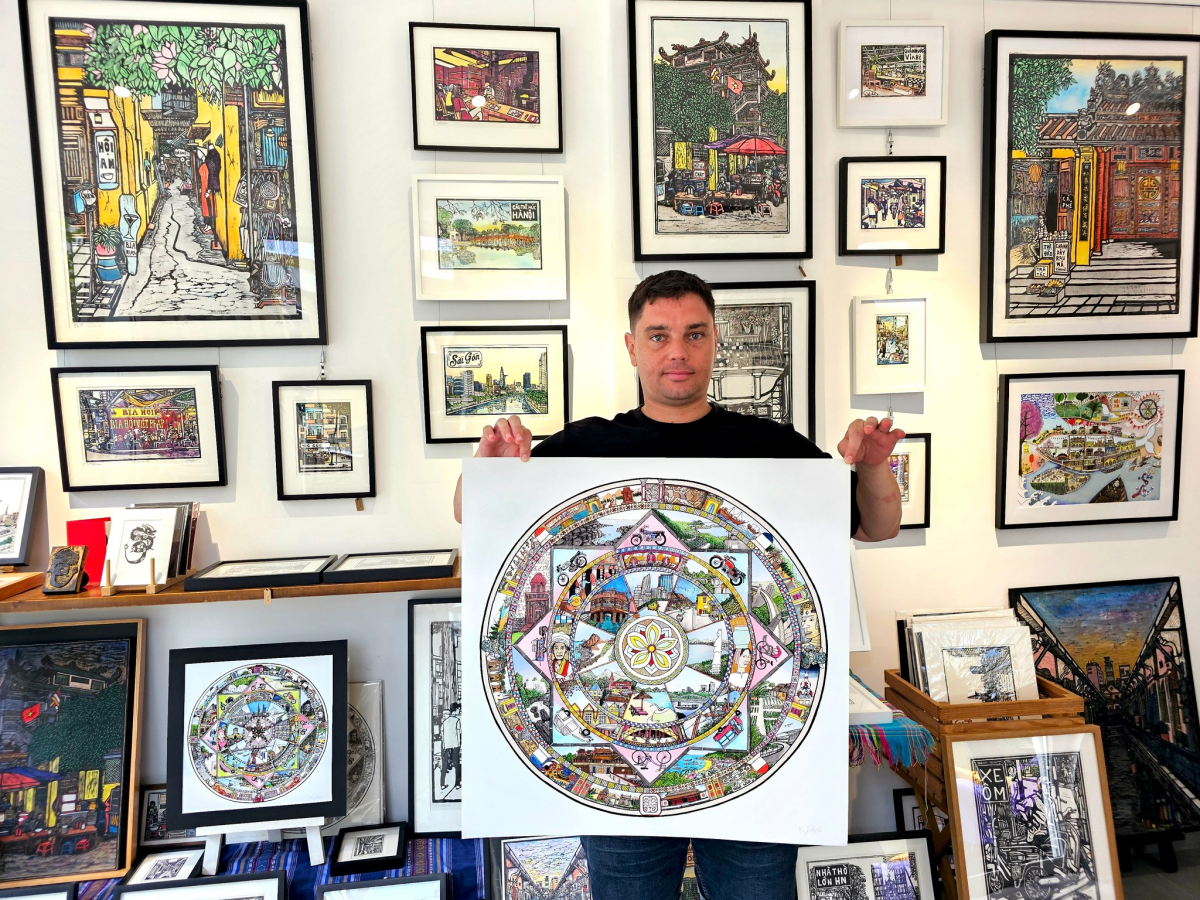
His “Oil & Water” technique adds another dimension to this practice. Developed over years, the method combines reduction woodcut with watercolour, allowing oil-based inks and water-based pigments to resist and interact on the paper. The result sits between printmaking and painting, carrying both the structure of carved line and the unpredictability of hand-applied colour.
Today, Clayton works from his gallery studio on the ground floor of his family’s Vietnamese townhouse in Khanh Hoi. The space welcomes visitors to browse original woodcut prints, limited editions and reproductions, while also witnessing the artist at work.
Held in private collections around the world, Clayton’s work offers more than a souvenir of Vietnam. It is a vision shaped by craft, patience and lived experience, where every line, pattern and carved surface holds a story waiting to be found.