After four decades mastering the art of French ice cream, Bruno Aïm begins a new chapter in Vietnam. Inspired by tropical fruits, aromatic herbs and an extraordinary culinary landscape, the master artisan brings French savoir-faire into conversation with Vietnamese terroir, guided by craftsmanship, curiosity and an enduring desire to discover.
Your journey with ice cream began almost by chance in 1978. When did you realise it could become a lifelong craft?
I had just finished working in a small pastry shop and wanted only one thing: to join a great French house. In 1978, I joined Maison Dalloyau as an ice cream maker, despite never having made ice cream before. There, I discovered ingredients such as kiwi, passion fruit and mango, alongside a discipline that demanded great precision. I was fortunate to learn from professionals who immediately passed on their passion. From that moment, ice cream became a true field of expression for me.
What did houses such as Dalloyau and Fauchon teach you about excellence?
Rigor, certainly, but above all respect for the product. We worked with exceptional ingredients and were given the freedom to experiment. I remember discovering basil sorbet, which was remarkably innovative at the time. It taught me that craftsmanship is rooted in strong fundamentals, but there should always be room for curiosity.
.png)
After such a long career in France and Asia, why begin a new chapter in Vietnam?
I have been passionate about Asia for decades and have worked in the region since 2004. But Vietnam was different. On my first journey here with my friends Richard and Cyril, we were immediately struck by the richness of the terroir: the fruits, herbs, spices and extraordinary food culture, even on the street. Bruno Paris is therefore less about starting again than creating an encounter between French savoir-faire and Vietnamese culinary heritage.
How has Asia changed your understanding of flavour?
Asia is an extraordinary playground for chefs, pastry chefs and ice cream makers. The diversity and quality of the ingredients make you feel that almost anything is possible. My years in Macau introduced me to flavours that could be fresher, spicier and more unexpected. Vietnam continues that journey of discovery.
How do you bring French craftsmanship and Vietnamese flavours together without one overshadowing the other?
It is about balance. We want to explore distinctly Asian flavours such as pandan, longan, lychee, mangosteen, jackfruit and green tea, while also introducing essential French classics such as vanilla, strawberry, caramel and coffee. We are even considering a sugarcane sorbet. The possibilities here are fascinating.
.png)
Why was it important for Bruno Paris to produce locally rather than simply import a French product?
Producing in Vietnam gives Bruno Paris its identity. It allows us to work directly with fresh ingredients, contribute to the local economy and create products that respond naturally to Vietnamese tastes. The project only makes sense if we respect the country and its terroir.
Which Vietnamese ingredient has surprised you most?
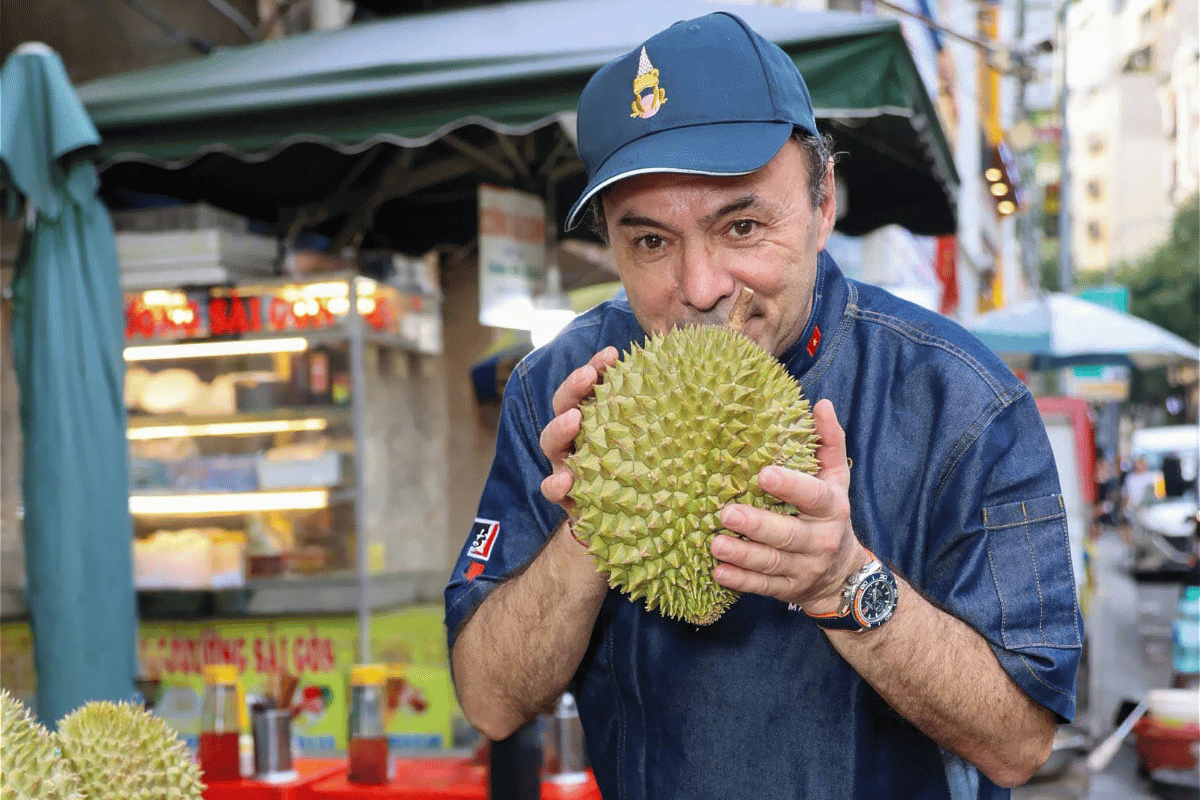
Durian. It has an incredibly strong personality, yet it can produce wonderfully rich ice cream. I am equally fascinated by Vietnamese herbs and spices, particularly coriander and mint. There is still so much for me to discover.
When encountering an unfamiliar ingredient, how do you transform it into ice cream?
I begin by tasting it exactly as it is. I need to understand its personality, acidity, texture and identity before thinking about technique. I am not interested in giving Vietnamese fruits a “French” taste. My role is to use the technique I have acquired over decades to reveal the ingredient as truthfully as possible.
.png)
After creating hundreds of flavours, what still excites you?
Discovery. Perfecting a classic requires precision, but encountering an ingredient I have never worked with takes me back to my beginnings. I taste, experiment, make mistakes and begin again. Even after more than 40 years, I know I have not tasted everything. That is what keeps the craft exciting.
What does artisan ice cream mean in an increasingly industrialised food world?
It means uncompromising attention to ingredients and technique. We use real vanilla pods rather than flavourings, and we work with fruit at the right moment in its season. For a fruit sorbet, for example, the fruit content can reach around 70%, compared with around 20% in an industrial product. It creates an entirely different experience. Craftsmanship is ultimately about allowing the quality and integrity of the ingredient to speak for itself.
.png)
Bruno Paris is also built around friendship. How important has that been to this new adventure?
Richard has been my friend for 20 years and Cyril for 15. We complement one another naturally: Richard understands the local landscape, Cyril brings an abundance of ideas, and I bring the technical expertise. Trust is fundamental when you embark on something new together.
Vietnam already has its own culture of desserts, tropical fruit and ice cream. Will Bruno Paris adapt to local tastes or introduce a distinctly French approach?
Both. We want to respond to Vietnamese preferences and celebrate the local terroir while maintaining a distinctly French approach to craftsmanship, technique and creation. It is not about choosing one culture over another, but finding the point where the two can meet naturally.
Could Bruno Paris eventually become a way of passing French ice cream savoir-faire to a new generation in Vietnam?
Absolutely. In time, we would like to teach the techniques behind French ice creams and sorbets in Vietnam and introduce the craft to a wider audience. Transmission is an important part of craftsmanship.
.png)
Looking five years ahead, what would make Bruno Paris a success?
Above all, the quality and relevance of our products, strong relationships with hospitality and restaurant partners, and a loyal, engaged team. I have worked with Le Train Bleu in Paris for 39 years. I believe collaborations should always be approached with the intention of building something lasting.
After more than four decades, what keeps you creating?
Perhaps it is less about passion than curiosity. Passion can change over time, but the desire to discover remains. Every fruit season, every new ingredient, terroir and encounter offers another opportunity to learn. I have created hundreds of flavours, yet I still feel there is so much left to explore. To me, being an ice cream maker is not about repeating what you already know. It is a constant journey of discovery. And after all these years, the reason I continue is very simple: every morning, I still wake up wanting to create something better than I made the day before.